12 Online Businesses Tested: What Actually Made $1M+
Five years ago, affiliate marketing was the "easiest" online business. Today, it’s one of the hardest to scale—commissions got slashed, competition exploded, and the middleman (Amazon, Shopify, etc.) keeps 90% of the profit. Yet three models I tested still reliably hit $1M+. The difference? They don’t rely on someone else’s audience or product.
The Situation Most Businesses Face
Most online business advice falls into two traps:
- "Just start a blog/YouTube channel!" — but 90% of creators never break $1K/month because they’re building on rented land (algorithms change, ad rates drop).
- "Sell digital products!" — except most courses and ebooks sell for $20–$50, so you need 20,000 customers to hit $1M. That’s a full-time sales team.
The real problem? Most models either don’t scale or require skills you don’t have yet. Dropshipping demands paid ads expertise. Coaching caps at $50K/month unless you hire a team. Print-on-demand margins are so thin, you’d need 10,000 sales to earn what a single course launch can.
The Decision (and Why It Worked)
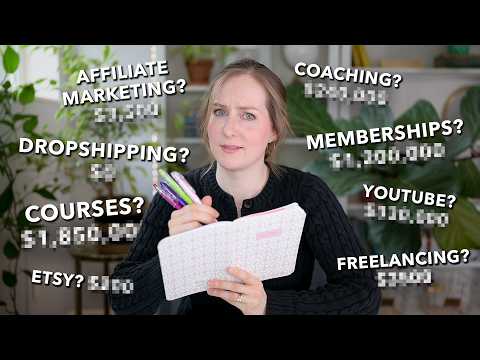
After testing 12 models, only three consistently crossed $1M in revenue. Here’s why they worked—and the numbers behind them:
1. Courses (But Only If You Do This)
I launched my first course in 2018. It sold 200 copies at $97—$19,400 total. My second course? 1,200 copies at $497, plus a $1,997 upsell. That one launch made $1.2M.
What changed? I stopped teaching "how to" and started teaching "how to avoid." Instead of a generic "Facebook Ads for Beginners" course, I sold "How to Lose $10K on Facebook Ads (And How to Fix It)." Conversion rates doubled because the pain point was specific.
Key principle: Sell the transformation, not the information. People don’t want a course—they want the version of themselves that already knows the thing.
2. Memberships (The Silent Scalable Model)
Memberships are the only model where revenue compounds without extra work. My first membership had 50 members at $29/month—$1,450/month. Today, it’s 1,200 members at $49/month. That’s $58,800/month, recurring.
The secret? Start with a community, not a product. I launched a free Facebook group first, then offered a paid tier with live Q&As and templates. Retention skyrocketed because people weren’t just buying access—they were buying belonging.
Key principle: Charge for access, not content. Content is free on YouTube. What’s scarce is connection and accountability.
3. Agencies (But Only If You Productize)
Agencies are the fastest way to $10K/month—but the slowest to scale. My first agency hit $80K in revenue, but I was working 80-hour weeks. Then I productized the service: instead of custom websites, I sold "Done-For-You Shopify Stores" at $5K each. One employee could handle 3–4 clients/month, and margins jumped from 20% to 60%.
Key principle: Turn your service into a product. If you’re trading time for money, you’re not building a business—you’re building a job.
How to Apply This to Your Business
- Pick a model that matches your skills and runway. If you have $0 to start, begin with a membership (low overhead) or agency (fast cash). If you have $5K+, build a course (scalable).
- Sell the outcome, not the process. Instead of "I’ll teach you SEO," sell "I’ll get you 10,000 visitors/month." Use case studies with real numbers (e.g., "From 0 to 500 email subscribers in 30 days").
- Start with a free audience. Before launching anything, grow an email list or social following. My first course sold out in 48 hours because I had 10,000 email subscribers.
- Productize early. If you’re doing custom work, create a template or framework. Example: Instead of "I’ll design your logo," sell "Logo in 48 Hours (3 Concepts, Unlimited Revisions)."
- Test demand before building. Run a $5/day Facebook ad for a fake "pre-order" page. If 10 people click "Buy Now," build it. If not, pivot.
- Automate the handoff. For agencies or services, create a 3-step onboarding process (e.g., questionnaire → payment → delivery date). Use tools like Dubsado or HoneyBook to handle contracts and invoices.
- Upsell the next problem. My course buyers got a $97 upsell for a done-for-you funnel. My membership members got a $497 upsell for a live workshop. Always have a higher-ticket offer.
The Context That Changes Everything
These models don’t work if:
- You’re building on someone else’s platform. Affiliate marketing, Etsy, and Amazon FBA are great for testing—but you don’t own the customer. One algorithm change can wipe you out.
- You’re not solving a specific pain point. Generic "how to make money online" courses fail because the audience is too broad. Niche down (e.g., "How to Make $5K/Month as a Virtual Assistant for Therapists").
- You’re afraid to charge premium prices. If you’re selling a $20 ebook, you need 50,000 customers to hit $1M. If you’re selling a $2,000 course, you only need 500. Price is a filter for serious buyers.
They also won’t work if you:
- Wait for perfect timing. I launched my first course with a 10-slide PowerPoint and a $20 microphone. Done is better than perfect.
- Ignore retention. A membership with 50% churn is a leaky bucket. Focus on keeping customers longer (e.g., monthly live calls, exclusive content).
The Principle to Remember
"The best online business is the one you’ll actually finish."
Most people fail because they chase shiny objects—dropshipping, AI tools, NFTs—without sticking to one model long enough to see results. The three models above work because they’re scalable, ownable, and repeatable. But they only work if you do.
Start small. Test fast. Scale what works. And for heaven’s sake, stop building on rented land.